Reverse Mortgages
Is Forgiven Mortgage Debt Taxed? Real Answer
 Toni Taylor Gazza · NMLS #274323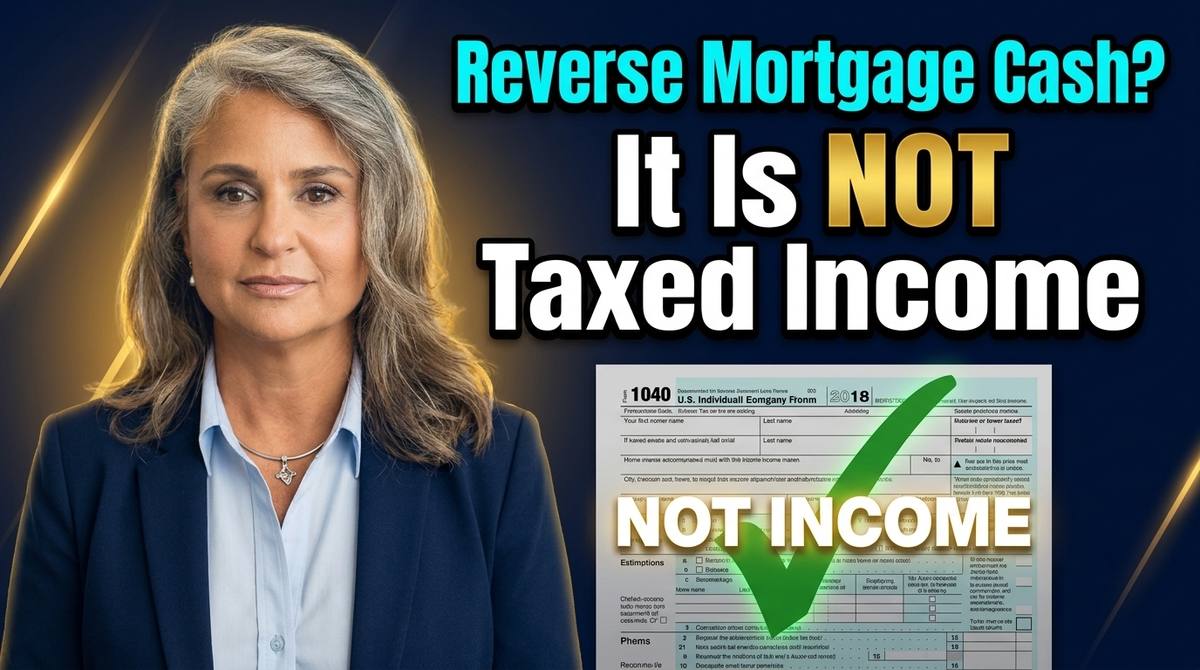
Is the money from a reverse mortgage taxed as income?
No. Money you receive from a reverse mortgage is generally not taxed as income because it is a loan advance against your own home equity, not income. Borrowed money has never been taxed as income. This is separate from the Mortgage Forgiveness Debt Relief Act, which deals only with debt a lender cancels or forgives.
Money you pull from a reverse mortgage is generally not taxed as income. Not a dollar of it. It is a loan advance against your own home equity, and borrowed money has never counted as income. That is completely separate from the Mortgage Forgiveness Debt Relief Act, which only applies when a lender cancels or forgives part of what you owe. Two different rules that get mixed up all the time.
Almost every week, someone in their sixties or seventies asks me if that Debt Relief Act they keep hearing about means they will owe a giant tax bill on their reverse mortgage cash. The answer is no, and the mix-up scares good people out of a decision that could let them stay in the home they planned to grow old in.
So let me untangle this slowly. If you are on a fixed income, one wrong assumption about taxes can freeze you in place for years.
Why do people confuse these two rules?
Here is where the confusion starts. Both of these things have the word mortgage in them. Both touch taxes. So the brain files them in the same drawer. They do not belong in the same drawer.
Retirement also makes people cautious about anything with the word tax attached, which is smart. But caution built on a mixed-up fact just keeps you stuck.
What is the Mortgage Forgiveness Debt Relief Act?
In plain English, this rule is about what happens when a lender cancels or forgives part of what you owe on a home loan. Say a homeowner owes more than the house is worth, and the bank agrees to wipe out some of that balance.
Normally the IRS treats forgiven debt like income. You did not pay it back, so on paper it looks like you came out ahead, and they can tax you on it. This Act was written so that, in certain qualifying situations, that forgiven mortgage debt does not get counted as taxable income.
Notice the whole thing hangs on one word. Forgiven. This is a rule for people who had debt erased. A short sale. A loan modification where the bank knocked down the balance. That is the world this Act lives in. If you want a broader look at how debt cancellation works, the Consumer Financial Protection Bureau explains debt relief programs in plain terms.
Why is a reverse mortgage different?
Here is the part where people slam the brakes for no reason.
A reverse mortgage is not forgiven debt. It is the opposite. You are not having a balance erased. You are borrowing against the value of a home you already own. The money you receive is a loan advance. It is money you are borrowing, plain and simple.
Borrowed money has never been income. When you take out a car loan, nobody taxes you on it. Same idea here.
So the money from a reverse mortgage is generally not taxable, because it was never income to begin with. It is your own equity, handed back to you in cash.
Does a reverse mortgage affect Social Security?
Because the proceeds are a loan and not income, reverse mortgage cash does not by itself count as income for Social Security calculations. It does not reduce your monthly Social Security check on its own. That is a huge relief for someone living on a fixed check every month.
I stay careful here. How any of this lands depends on your full financial picture, including whether any part of your Social Security is already taxable. Need-based programs can work differently than Social Security retirement benefits, so your own numbers matter.
What does this look like for a real homeowner?
Picture a homeowner who owns her place free and clear. The house is paid off. But the insurance renewal doubled. The HOA dropped a special assessment for the roof. And her monthly bills are eating the bulk of her Social Security.
She hears there is a way to erase her monthly mortgage payment and pull some cash out. Her very first thought is, wait, am I going to get taxed on that money. So she does nothing. She keeps skipping the air conditioning the month the insurance is due.
She froze over a tax rule that does not even apply to her.
Here is what I want you to hold onto. The forgiveness rule is about debt someone erased. The reverse mortgage is about equity you are borrowing against. One is a cancellation. The other is a loan. They do not overlap.
Should you confirm the tax side with a professional?
Yes, always. I am a mortgage professional, not a tax advisor. How any tax rule lands on your specific return depends on your other income, your filing situation, and whether any part of your Social Security is already taxable.
That is exactly why one piece of my Whole Picture Reverse Method is sitting down and mapping your whole situation before anyone recommends a single thing, and confirming the tax side with a qualified tax professional who looks at your actual numbers. Never guess on this. Never take a stranger's word for it. Get it checked against your own return.
What is really at stake here?
It was never about the tax on the money. That was a mix-up. The real question underneath it is whether you can stay in your home without draining what little you have left.
You cannot answer that with a rule you heard on TV. You answer it by putting your bills now next to your bills after, side by side against your income, and seeing the actual gap on paper. That is the moment things get clear for people. Not a brochure. Their own numbers.
If you have been sitting on this, half worried about a tax bill that probably does not even apply to your situation, let me take the guesswork off your plate. Book a free discovery call with me. We will look at your whole picture, loop in the right tax professional for your specific return, and if a reverse mortgage is not the right fit for you, I will tell you straight. No pressure and no fees to talk. Bring your kids in on the call if you want another set of eyes.
This article is for educational purposes only and is not tax, legal, or financial advice. Please consult a qualified tax professional about your specific situation.
Frequently asked questions
Is the money from a reverse mortgage taxed as income? +
Generally no. Money you receive from a reverse mortgage is a loan advance against your own home equity, not income. Because borrowed money has never been treated as income, reverse mortgage proceeds are generally not taxed. This is different from forgiven or canceled debt, which the IRS can treat as taxable income in some cases. Your specific situation depends on your full financial picture, so confirm the tax treatment with a qualified tax professional who reviews your actual return.
What does the Mortgage Forgiveness Debt Relief Act actually cover? +
The Act deals with situations where a lender cancels or forgives part of what you owe on a home loan, such as a short sale or a loan modification that knocks down the balance. Normally the IRS can treat forgiven debt as taxable income because you did not pay it back. This Act allows certain qualifying forgiven mortgage debt to not be counted as taxable income. The whole rule hangs on one word: forgiven.
Why do people confuse forgiven mortgage debt with reverse mortgage proceeds? +
Both have the word mortgage in them and both touch taxes, so the brain files them together. Retirement also makes people cautious about anything with tax attached. But they are opposites. Forgiven debt is a balance someone erased for you. A reverse mortgage is money you borrow against equity you already own. One is a cancellation and the other is a loan. They do not overlap, and mixing them up can freeze people out of a good decision.
Does a reverse mortgage affect my Social Security check? +
Reverse mortgage proceeds are a loan, not income, so they do not by themselves count as income for Social Security calculations and do not reduce your retirement check on their own. That said, need-based programs can work differently, and whether any part of your Social Security is already taxable depends on your other income. Map your full picture and confirm with a qualified tax professional before making a decision.
Should I get tax advice before taking a reverse mortgage? +
Yes. A mortgage professional can explain how the loan works, but how any tax rule lands on your return depends on your other income, filing situation, and whether part of your Social Security is already taxable. Always confirm the tax side with a qualified tax professional who reviews your actual numbers. Never guess and never rely on a general rule you heard on TV. Get it checked against your own return before you decide.
Sources
- What is a debt relief program and how do I know if I should use one? — Consumer Financial Protection Bureau
About the author
Toni Taylor Gazza — Founder & Mortgage Expert
NMLS #274323
Toni Taylor Gozza has spent her entire career — since 1990 — inside the mortgage business, and she's worked every channel of it: consumer finance, banks, wholesale lending, and mortgage brokering. She was one of the youngest people ever promoted into management at her company at age 21, and one of the very few people in the country to serve as a wholesale account executive with actual signing underwriting authority. Running an entire wholesale mortgage company gave Toni rare insight into what secondary markets and investors need to package and approve a loan. That underwriting-level understanding is exactly why she and her team can find a path for borrowers other lenders turn away, especially in the Non-QM space. Toni leads Interconnect Mortgage as an educator first. She won't sell you into a loan you don't need — she'll explain your options in plain English so you can decide for yourself. A Palm Beach County resident since 1992, she's active with the Junior League and the Couture Club, a local organization supporting children's foundations.
Ready to talk numbers?
Schedule a 15-minute call. We'll walk through your situation and show you what's actually possible — no pressure, no pitch.
Book a call

