Reverse Mortgage / Aging in Place
Home Sweet Home—or a Smart Sale? Let’s Run the Real Math

Should I age in place or sell my home and downsize in retirement?
There is no one-size-fits-all answer; it comes down to priorities and real math. Aging in place keeps your comfort and independence but carries ongoing costs like taxes, insurance, maintenance, and future care, which a reverse mortgage can help cover from your equity. Selling and downsizing offers lower monthly costs and less upkeep, funded by your net proceeds. Compare a reverse mortgage, a HELOC, and selling side by side with a trusted professional.
The Crossroads Many Families Face
If you’re a senior — or the adult child of one — you’ve probably asked the big question:
Is it better to age in place or sell the home and downsize?
It’s a conversation filled with emotion, numbers, and family opinions. On one side, there’s the comfort of home — the neighborhood, the memories, the sense of independence. On the other, there’s the appeal of a simpler life with fewer bills and responsibilities.
The truth? There’s no one-size-fits-all answer. But you can run the real math and make a choice that protects both your quality of life and your financial security.
1. The Real Cost of Staying Put
Aging in place sounds ideal — until you factor in the hidden costs.
If your home is paid off, that’s great — but there are still ongoing expenses to consider:
- Property taxes
- Homeowners insurance
- Maintenance and repairs (roof, AC, yardwork)
- Utilities and HOA dues
- Future in-home care or accessibility modifications
Even small leaks or outdated wiring can become big headaches on a fixed income. For some, those costs add up faster than expected.
A reverse mortgage can help bridge that gap — allowing you to access the equity you’ve built without selling your home or taking on a new monthly mortgage payment. The funds can be used to cover maintenance, in-home care, or medical costs, helping you stay where you feel most comfortable.
2. The Upside of Selling and Downsizing
On the flip side, selling your home can offer immediate relief and flexibility.
Downsizing to a condo, retirement community, or smaller home can mean:
- Lower monthly costs
- Less maintenance and physical stress
- Proximity to family, medical care, or amenities
The tradeoff? Leaving the home you love — and potentially facing higher property taxes or HOA fees depending on where you move.
If you sell, your net proceeds (after commissions, repairs, and moving expenses) can fund your next chapter — but you’ll want to consider how that cash will be managed for long-term stability.
3. Reverse Mortgage vs. HELOC vs. Selling: The Decision Matrix
When you’re deciding how to tap into your home’s equity — or whether to sell — it helps to see the pros and cons side by side.
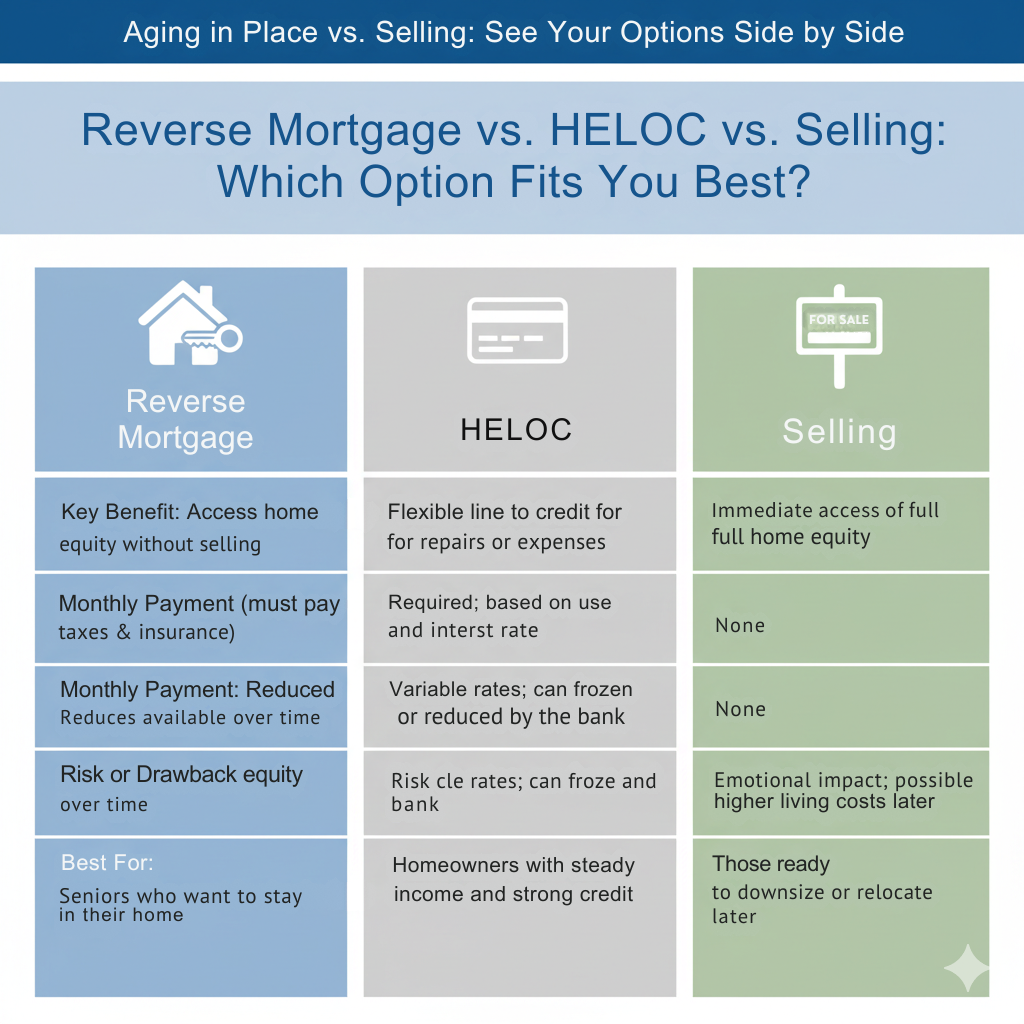
This matrix isn’t about right or wrong — it’s about priorities. If your goal is stability and staying home, a reverse mortgage might make sense. If you want cash in hand and freedom from maintenance, selling may be the way to go.
4. Real Story: Two Perspectives
Meet Carol and her son, Matt.
Carol is 74, retired, and loves her home of 30 years. Matt, her only son, lives two hours away and worries about her living alone.
They sat down to run the numbers. Carol’s roof needed replacing, and she wanted to update her bathroom for safety. Selling would give her about $400,000 after expenses. A reverse mortgage would free up $100,000 for updates while letting her stay in the home she loves.
In the end, they chose the reverse mortgage. Carol gained peace of mind, and Matt knew she had a safe, sustainable plan.
Every family’s “right” decision looks different — what matters is that you make it intentionally, not reactively.
Key Takeaway
Whether you age in place or sell, the goal is the same: to preserve your quality of life and financial independence.
The best next step? Review your full picture — home value, income, expenses, and care needs — with a trusted professional who can help you see all sides clearly.
Next Steps
Download our free Aging in Place vs. Selling Decision Checklist to weigh your financial, health, and legal considerations before you decide.
Custom HTML/CSS/JAVASCRIPT
Then, when you’re ready, book a free 15-minute call here: /book
Disclaimer
This content is for educational purposes only and not a commitment to lend. Interconnect Mortgage, a DBA of Palm Beach Mortgage Group Inc., NMLS 373094. Check licensing at NMLS Consumer Access.
Frequently asked questions
What are the hidden costs of aging in place? +
Even with a paid-off home, you still face property taxes, homeowners insurance, maintenance and repairs like roof and AC, utilities and HOA dues, plus potential in-home care or accessibility modifications. On a fixed income, those costs can add up faster than expected.
How can a reverse mortgage help me stay in my home? +
A reverse mortgage lets you access the equity you have built without selling your home or taking on a new monthly mortgage payment. The funds can cover maintenance, in-home care, or medical costs, helping you stay where you feel most comfortable.
What are the benefits of selling and downsizing in retirement? +
Downsizing to a condo, retirement community, or smaller home can mean lower monthly costs, less maintenance and physical stress, and proximity to family, medical care, or amenities. The tradeoff is leaving the home you love and potentially facing higher property taxes or HOA fees where you move.
Is a reverse mortgage, a HELOC, or selling the better option for seniors? +
It is about priorities, not right or wrong. If your goal is stability and staying home, a reverse mortgage might make sense; if you want cash in hand and freedom from maintenance, selling may be the way to go. Reviewing the options side by side with a trusted professional helps you see all sides clearly.

About the author
Toni Taylor Gozza — Mortgage Expert
NMLS #274323
I'm Toni Taylor Gozza, a Mortgage Expert with Interconnect Mortgage in Palm Beach Gardens, Florida, NMLS #274323. I help self-employed borrowers, first-time buyers, and people with complex income or substantial assets explore mortgage options that fit how their finances actually work. My approach is education first: I explain the choices in plain English so you can make an informed decision without being pushed into a loan you don't need. Credentials: NMLS #274323; Interconnect Mortgage, a DBA of Palm Beach Mortgage Group Inc., NMLS #373094 Expertise: Non-QM & creative financing, asset depletion, self-employed borrowers, first-time buyers
More about Toni →Ready to talk numbers?
Schedule a 15-minute call. We'll walk through your situation and show you what's actually possible — no pressure, no pitch.
Book a call

