First Time Home Buyers
Buy Now vs. Wait One Year vs. Wait Two Years — The Real Math

Should I buy a home now or wait for lower mortgage rates?
If you're financially ready, waiting is usually the bigger risk. The math shows waiting one year for lower rates typically means a higher payment because prices rise, and waiting two years barely improves the payment while costing time and equity. Inventory stays tight because builders pulled back, and pent-up demand — first-time buyers now median age 40 — surges back when rates dip. Rates can be refinanced later; the purchase price is permanent.
Before you read this, ask yourself one question:
What if mortgage rates drop next year — but home prices rise faster than the rate drop helps you?
That’s the part most buyers never actually run the math on.
Right now, millions of people are waiting for a “better” interest rate. Builders slowed down. Inventory stayed tight. Prices didn’t really fall. And first-time buyers are older than they’ve ever been.
When rates ease, those buyers don’t return slowly.
They come back all at once.
This isn’t about predicting the market.
It’s about understanding what happens when everyone waits for the same moment.
Builders Pulled Back — And That Matters More Than Rates
When interest rates rose, builders didn’t ramp up construction. They pulled back.
- New construction slowed
- Labor and material costs stayed high
- Permits and development still take years, not months
Even if rates drop, new homes won’t show up fast enough to meet demand.
That’s why inventory remains tight — and why competition tends to return quickly when buyers re-enter the market.
Pent-Up Buyers Didn’t Disappear — They Aged
According to the National Association of Realtors, the median age of a first-time homebuyer is now 40 years old — the highest on record.
That tells us something important:
- People still want to buy
- They’ve been delayed, not discouraged
- Many are financially stronger than past first-time buyers
When rates improve even slightly, this group doesn’t trickle back into the market.
They surge back.
Waiting Didn’t Stop Prices From Rising
A common belief is that waiting protects buyers from rising prices.
That hasn’t been true.
Across Florida:
- Home prices stayed elevated
- Inventory stayed limited
- Demand stayed steady in desirable areas
A Palm Beach County Reality Check
Two years ago, many buyers waited because rates felt “too high.”
Today:
- Home values are higher than they were then
- Buyers who purchased gained equity
- Buyers who waited missed appreciation and now face higher prices
That’s the quiet cost of waiting — it doesn’t feel painful at first, but it adds up.
Let’s Slow This Down and Look at the Math
Most buyers assume waiting for lower rates automatically means a lower payment.
That only works if prices stay flat — and history shows they usually don’t.
To keep this comparison simple and apples-to-apples, the example below assumes a 20% down payment (80% loan-to-value). Many buyers qualify for lower down payment options, which we’ll address below.
(Same type of home. Same loan term. Only price and rate change.)
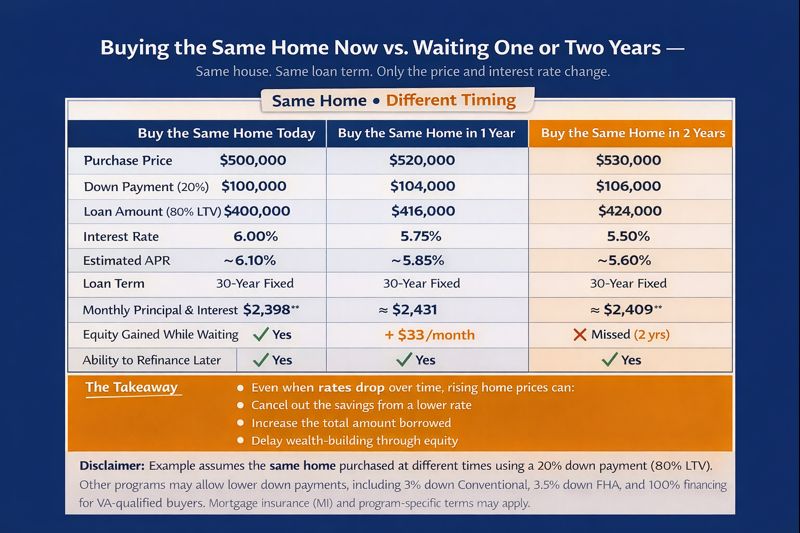
What This Comparison Is Really Showing You
At first glance, lower rates feel like the win.
But when prices rise at the same time:
- Loan amounts increase
- Monthly payments don’t drop the way people expect
- And years of potential equity are lost
Waiting one year results in a higher payment.
Waiting two years barely improves the payment — but still costs time and equity.
Rates are temporary.
Purchase price is permanent.
You can refinance a rate later.
You can’t refinance what you paid for the house — or the appreciation you missed while waiting.
This Example Isn’t One-Size-Fits-All — And That’s the Point
This comparison assumes 20% down for clarity, not because it’s required.
There are programs that allow:
- 3% down Conventional
- 3.5% down FHA
- 100% financing for VA-qualified buyers
Mortgage insurance and program-specific terms may apply, but the core lesson stays the same:
when prices rise, lower rates don’t always save you money.
The Wealth Gap Tells the Bigger Story
Here’s a stat that puts all of this into perspective:
- Median net worth of homeowners: ~$430,000
- Median net worth of renters: ~$10,000
That means homeowners are about 43 times wealthier than renters on average.
That gap didn’t come from perfect timing.
It came from owning an appreciating asset over time.
Why “Buy When You’re Ready” Often Beats “Wait for Perfect”
The real risk isn’t buying at today’s rate.
The real risk is:
- Waiting while prices rise
- Facing more competition later
- Paying more for the same home
- Or staying stuck renting while equity passes you by
There is no perfect time.
There is only prepared vs. unprepared.
Final Thought
Buying a home isn’t about beating the market.
It’s about positioning yourself wisely inside it.
If you’re financially ready today, waiting for perfection may quietly cost you opportunity.
If you want clarity on how this applies to your situation, the first step is a conversation — not pressure.
👉 /book
Disclaimer:
This content is for educational purposes only and not a commitment to lend.
Interconnect Mortgage, a DBA of Palm Beach Mortgage Group Inc., NMLS 373094.
Licensed in Florida.
Check licensing at NMLS Consumer Access.
Frequently asked questions
If mortgage rates drop, won't my payment be lower if I wait? +
Only if prices stay flat — and history shows they usually don't. In the article's apples-to-apples comparison (same home, same loan term, 20% down), waiting one year results in a higher payment, and waiting two years barely improves the payment while still costing time and equity.
Why hasn't waiting protected buyers from rising prices? +
Across Florida, home prices stayed elevated, inventory stayed limited, and demand stayed steady in desirable areas. In Palm Beach County, buyers who waited two years ago now face higher values, while buyers who purchased gained equity.
Do I need 20% down to buy a home? +
No. The 20% down example was used for clarity, not because it's required. There are 3% down conventional programs, 3.5% down FHA, and 100% financing for VA-qualified buyers. Mortgage insurance and program terms may apply, but the core lesson stays the same.
What happens to the housing market when rates finally drop? +
Pent-up buyers don't return slowly — they come back all at once. Builders slowed construction, permits take years, and the median first-time buyer is now 40 years old and financially stronger than past buyers. When everyone waits for the same moment, competition returns quickly.
Is buying a home really that important for building wealth? +
The gap is striking: median homeowner net worth is about $430,000 versus about $10,000 for renters — roughly 43 times wealthier. That gap didn't come from perfect timing; it came from owning an appreciating asset over time.

About the author
Toni Taylor Gozza — Mortgage Expert
NMLS #274323
I'm Toni Taylor Gozza, a Mortgage Expert with Interconnect Mortgage in Palm Beach Gardens, Florida, NMLS #274323. I help self-employed borrowers, first-time buyers, and people with complex income or substantial assets explore mortgage options that fit how their finances actually work. My approach is education first: I explain the choices in plain English so you can make an informed decision without being pushed into a loan you don't need. Credentials: NMLS #274323; Interconnect Mortgage, a DBA of Palm Beach Mortgage Group Inc., NMLS #373094 Expertise: Non-QM & creative financing, asset depletion, self-employed borrowers, first-time buyers
More about Toni →Ready to talk numbers?
Schedule a 15-minute call. We'll walk through your situation and show you what's actually possible — no pressure, no pitch.
Book a callRelevant loan programs
Related articles

Buy Now or Wait? Why Even Conservative Appreciation Assumptions Matter More Than You Think

What Determines Your Mortgage Interest Rate? (It Is Not the Same for Everyone)